Find just about any keyboard synthesizer online at zzounds.com
For many years Russian Federation has been an isolated economy. Ministry of Culture, for example, wouldn’t allow import of foreign instruments and Soviet musicians at the time didn’t have a musical instrument that would offer capabilities and sounds of the equipment available to the rest of the world. This had triggered creation of a completely new and unique instrument.
Polivoks was designed by an engineering team lead by Vladimir Kuzmin from the Urals Vector Company later built by Formanta Radio Plant in the early 80’s. First commercially available Polivoks was sold in 1982 with the last unit sold in 1990. Polivoks is one of the most popular vintage synths today because of its history and extraordinary industrial look. Many consider its sound capabilities to be comparable to a MiniMoog.
As one of the most extraordinary vintage synths, Polivoks deserves to be properly documented and preserved. Large portion of the information contained on this page has been sourced from various online resources.
POLIVOKS is a polyphonic 2 OSC analog synthesizer. It features a unique set of electronic parts, reliable keyboard (49 notes F–E) made in magnetically controlled contacts; synthesis modules consist of independent boards, which is convenient for maintenance. The synthesizer has 2-voices polyphony; each oscillator works with a keyboard note independently; two types of filters – bandpass/lowpass and external input for cutoff control. In addition, Polivoks is housed in an original body of uncommon design with handy controls. Being closed with a cover, the synthesizer turns into a strong aluminum case.
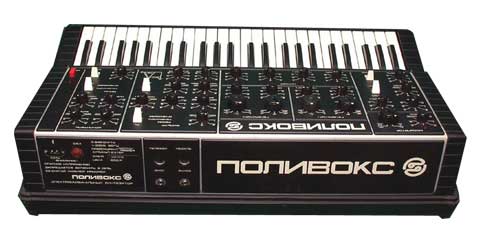
Polivoks Rear View
| Mains voltage of alternating current, V | 220 |
| Power consumption, W | max 10 |
| A range of operating temperature, C | -10 / +35 |
| Relative generator drift over 4 hours continuous work is within, % | max +/- 05 |
| Total musical range overlaped by main generators, Hz | 21,8 (F of subcontra octave), + 5274 Hz (E of fifth octave) |
| Tuning range of the main generators, % | min +/- 12 (+/- 1 tone) |
| Detuning range of the second generator, % | min +/- 25 (+/- 2 tone) |
| Frequency change range of the cutoff frequency of the filter, Hz | min 100 + 10000 |
| Dynamic range of the synthesizer, dB | min 60 |
| Inlet voltage of the synthesizer in a load 10 kOm | |
| Low output voltage, V | 0,025 |
| High output voltage, V | 0,25 |
| Dimensions of the synthesizer, mm | 780?490?195 |
INTERVIEW BY POLIVOKS.COM IN 2005
How did all this began ? Did you have a dream as a young boy ? Did you make a bet with friends at the university ? How did you come to build an analog synth ?
Vladimir Kuzmin: Till the age of 10 I dreamt of becoming a painter but later I began to be interested in technic that lead me to radioelectronics. At the same time I studied to play piano and guitar and later both music and electronics knowledge helped me as a participant of a band at school and later at the university band.
After graduating the university I began to work at a factory where already was a bureau where some enthusiasts were engineering first electronic musical instruments and sound reinforcement equipment.
The synth is duophonic not polyphonic, so why the name Polivoks ?
VK: Name Polivoks mainly stands for multi timbres, in Russian it sounds in such meaning, although the real poliphony can be played with only two voices.
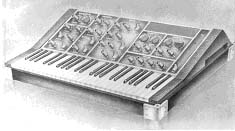 Did the modular synths existed in Russia before the Polivoks’era ?
VK: The main historic events about electronic musical instruments are well known now including attempts of Russian inventors and engineers beginning from Theremin. Among them are theremins, electric organs with various principles of generating sound including photooptic, string (or ribbon) bars, magnet reading heads, valve or transistor generation and so on. But I don’t remember something similar to what we call now “modular” although every experimental sample of electronic keyboard ever recalls modular.
Was the polivoks inspired by a famous american or japanese synth ? Did you have contacts in the west with other engineers and developers ? Or are you in the tradition of Teremin ?
VK: What contacts? What are you talking about? The only thing what we could do at that time as an engineer was to read Russian and foreign patents and literature. And sometimes to see the real electronic organs and synths at the professional music bands. Remember that I lived in the Urals which are thousands miles away from Moscow, so it was very rare that once or twice a year our city visited a professional band, and it was not the fact that this band had modern keyboard. More frequently we heard LPs with the sounds of synths. Of coarse our first goal was to give non-professional musicians something with modern bank of sounds similar to what they hear on LPs and it was not so important wether they’d look like Moog, Roland, Korg’s synths or not.
What kind of music did you listen to in the 70-80’s ?
VK: The Monkees, The Beatles, Creadence CWR, Beach Boys and others but it was hard and very expensive to have the original LPs, but we tried to get them from the friends and to copy to the magnet band recorders.
 How many persons worked on the Polivoks developement ? Who are they ?
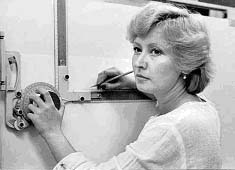
VK: I as a leading engineer and circuit designer, exterior and graphics designer Olimpiada Kuzmina and Yuri Pheophilov as hardware engineer.
The design of Polivoks is unique and beautiful. Your wife Olympiada made it. What were her inspirations (UFO’s ? tanks ? Other synths’ design ? …)
VK: Well, Olimpiada was (and is) as a diploma designer very skilled in various styles of design, so our main idea was to give to the amusing thing ,which was the synthesizer itself at that time, the same amusing design. All the American and japan synths of that time have inexpressive design, and we decided that our synth will, first, reflect its internal structure (the bulges with graphics on the front and back panels), second, will be made in military style to underline its sound secrecy (black forms and trucks, heavy, reliable) and, third, will be friendly to the customers (Cyrillic graphics, clear signal structure).
During the polivoks’ conception, did you intend to find this unique sound ? Did you want the filter to sound so wild ? Was the sound your priority at the time ?
VK: Yes, the sound was on the first place. We simply wanted the musicians to have the same colors of sound that all American and japan synths have. But at that time I didn’t know that for example the ordinary sawtooth signal can sound so different on the different analog synths and this depends on electronic circuits and components and their combinations. And of coarse I wanted the VCF to sound so sweety as on Minimoog. It seemed to me that VCF was the most complex module among all others. So I’ve spent hardly a year to develop the schematics of filter that was very different from others. And when I’ve found the decision I liked it very much from the first moment- it was very simple: itself it had a pair of ICs, 6 resistors and no capacitors at all. The only thing I didn’t like that it was of the second order and that it sounded a little bit wildish.
How many polivoks were produced in the 80’s ? Was it an expensive synth for the musicians ?
VK: The price was 920 roubles in the stores (near 15 hundreds dollars) so not every musician could buy it, may be only those who played in restaurants. But it was not expensive for cultural organizations to buy Polivoks. I don’t know the end figure but the amount of Polivokses manufactured could have reach 20000-30000 pieces.
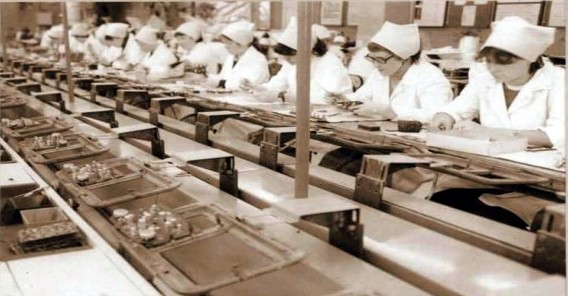
Formanta Production Line
Did the Polivoks become famous in Russia and ex-USSR ? Who were the famous Polivoks players ? Did the russian put the sound of this synth in particular effects or echo chambers ? Which one ?
VK: Its better to say not famous but well known and popular. I think that the factory had no facilities to satisfy the need of the market because the annual program was already sold in the very beginning of the year. The plant received many letters from the musicians from little towns and villages and from the lone musicians with the appeals to sell a synth.
How to use Polivoks was the deal of the musician so I cannot describe the precise gear setup, it could be various.
Why is there such differences in the sound between early Polivoks and those produced after 1985 ? Was it a problem of VCO’s instability ?
VK: Well, VCO being correctly set and tuned at the factory has great stability not worth then others and even better. But the quality control at the factory was not good so in many cases they outputted working machines (they all sounded, all knobs worked, and oscillators were in tune for the inner temperature) but as the thermal stability circuitry tuning process was enough complex and took many time they often missed it.
I didn’t compare the earlier and later versions of the synth because I didn’t have them both at the same time. Also there were no dramatic changes in schematics except filter modification, in latest version it had some improvements directed to more sound smoothness. May be this is the reason.
Why is there no pitch and modulation wheels on the Polivoks ? Did you want to make the use of the synth close to the accordion ? (long tradition in Russia). Why are the keys so light to play with ? did you intend to build something radically different from the classical “Pratt and reed” keyboard ? (Minimoog, Odyssey, Pro-one…etc).
VK: At that time we had no good engineer decision of the wheel module so it was decided to make it later (37 knobs and switches enough for the beginning). Later we employ joystick for later synth like Maestro and VS34 and planned to incorporate it somehow into Polivoks.
Hmmm, you mean button accordion? Our factory manufactured electronic portable button accordion Topaz but it was more close to the electronic organ.
The keyboard of the Polivoks is designed with the full correspondence to the Russian standards which sets all the pressing force figures. This keyboard you can find on all our instruments of that time. Later we manufactured instruments with the better keys moving more smooth, more soundless and it looked better (Maestro, VS34, Arton IK51).
Someone said here and there that it was possible to play Polivoks in winter in the middle of the Taïga, is that true ?
VK: Why not, if it was warm enough in the bulding ?
Nowadays electronic products are made of bad plastic. Even the professional synths look fragile. Polivoks is build like a tank. Was it a priority for you: Solid as a rock and almost…waterproof ? What do you think about the synthesizers of 2005 ?
VK: I and Olimpiada are happy that the design of the Polivoks is so catchy nowadays! We have achieved our goal. All other synths look more like the apparatus than some funny things, and it seems to me they are very similar except their colours.
Do you use Vodka to clear the potentiometers’ contacts in Polivoks ?
VK: No way! What is good for Russians is bad for pots.
Sound of Polivoks can be like lava in fusion and as crystal clear and cold as ice. Does it have to do do with the character of russian’s women ?
VK: I’d compare its sound with brassy bad guy.
Is there a future for the Polivoks ? Do you think you will one day produce your synth again ?
VK: Maybe. I have enough innovative ideas as for mods of the Polivoks as for new products. But I’d like to know how many people will buy this all ?
Original script available from: http://www.polivoks.com/VladimirKuzmin.html
INTERVIEW BY SYNRISE
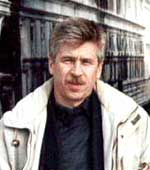 [Dargel] What was the reason behind building such a synthesizer?
[Kuzmin] Well, there was no other intention other than to offer soviet musicians the same colour in their musical palette as foreign musicians had. It’s not a secret that synths like other musical instruments were not imported by the Ministry of Culture. That’s why it was decided to manufacture the first analogue synth in the USSR. I was a young engineer and musician, that’s why I agreed to lead this team.
[Dargel] Some people are thinking, the Polivoks sounds a little bit like a Minimoog. Are there any influences by the technology of Dr. Moog?
[Kuzmin] Yes, Polivoks has a similar structure for audio signals as well as control signals. That’s why musicians could produce popular “moog-like” sounds. I think that most synths with the same structure must have similar sound. The difference is in the specific units and the way they are connected.
[Dargel] How many Polivoks were sold over the years and in which period was the synth built?
[Kuzmin] I don’t know the overall volume of sold units. It was designed in one year. The first synth was sold in 1982, the last – in 1990. In the middle of this period the best sales were near 20.000 – 25.000 synths per year. The retail price was 920 roubles (about $1500).
[Dargel] Was the Polivoks a one-man-design by yourself or were there more other people involved?
[Kuzmin] The Concept, electronics, technical ideas were of mine. Design-concept, graphics, promotion and overall inspiration were from my dear wife – Olimpiada. Of course, manufacturing something is a very complex thing. So thanks to many other people: designers, technologists, workers.
[Dargel] The sign on the Polivoks (and the webpage, too) looks a little bit like Ying & Yang or like “Twins”-astro-sign. What was the sense of this sign or what does it mean?
[Kuzmin] We don’t know how we came to this symbol, but it is the maunfacturers registered trademark for the Polivoks and other products. It has no meaning other than two stylised solderpoints on a PCB.
[Dargel] The Polivoks became popular in Germany after the synth-collector and -historian Mathias Becker showed the synth in his series “Synthesizer von Gestern” (Synthesizer from the past). Next was the opening of the Synthesizer Museum from Martin Newcomb in England (opened by Dr. Moog, and as someone said, destroyed by a flood). There was also a Polivoks in their collection. So more and more people learned about synth-manufacturing in the former Soviet Union. Then other synths became known (Yunost for example). What has going on in the USSR in those days? Are there many more synths on the way as we know today (especially interesting for the update of Synrise – I don’t have much information – only from the Aelita and the Polivoks)?
[Kuzmin] Well, imagine USSR of the late 70’s. Those were the years when the sound of synthesizers became very popular. Soviet musicians wanted to own such an instrument but… they were not imported. The Ministry of Culture bought a few of them for state stars and some other musicians bought them from Poland and Chechoslovakia. And what about thousands of other musicians, school- and student bands? The sounds of synthesizer were so attractive and magnificant…
I came to the plant in 1976 after graduating from the Mining Institute where I played on bass in the student’s band and was the sound engineer. Amongst other things the plant manufactured electronic musical instruments, amps and acoustic cabinets for 5 years. There were electric organs for children and youngsters. There were several plants at this time in the former USSR which manufactured electronic musical instruments: our – Vector and Formanta, Moscow’s plant (Lels), the plant in Murom (Yunosts, Aelitas), in Brjansk (I forget the brand name), in Zhitomir (Estradins), in Vilnius (Electronicas), in Riga (RMIF). They manufactured a lot of organs, electro pianos, synthesizers. But Polivoks was the one that had voltage-controlled schematics (was true analogue) and sounded more “moog-like”.
[Dargel] Polivoksmania is running thru the music-world. It must be crazy that after all those years, that this synth has become more and more a prestige-object to own. What do you think about that?
[Kuzmin] It’s wonderfull! I didn’t believe it until now. I still think that it is one of those virtual reality jokes (but a very pleasant joke). I never dreamt that my Polivoks will be standing in a row with Moogs. Thanks to all who extended the life of this synth.
Original script available from: http://www.synrise.de/history/interviews/polivoks/polivoks_e.htm
There are many scans and photos of Polivoks logos available on the internet but a high quality or printable version can be extremely, if not impossible to find. For that reason Analogik has illustrated the logo from scratch following strict geometry and font rules applied during the original logo design.
PLEASE READ BEFORE USE: Logo version available for download from this page is a 100% new and original artwork, and may therefore contain slight differences in comparison to the original version. If you use any of these logos for web, print or multimedia, make sure this notice is made clear to your audience.
A link back to http://analogik.com would be much appreciated.
Polivoks – Web Buttons


Polivoks Logo Black on White – Web Resolution

Polivoks Logo White on Black – Web Resolution

Polivoks Logo Bundle – Round Edge Version
Right click – Save As or Click for a High Resolution (300dpi printable) PNG image.
Written by admin