The discovery of novel, living nano-organisms growing on Triassic and Jurassic sandstones opened up an exciting area of research in 1997.
The existence of nano-sized organisms has been proposed for a number of years by geologists who refer to a range of mineralised structures in rocks as the fossil remnants of nanobacteria. Bacteria range in size from 150nm (Mycoplasmas)-50µm in diameter while the proposed nanobacteria are an order of magnitude smaller with diameters reported to range from 20nm-150nm.
Further interest in nanobacteria was fuelled by the discovery of similar nano-sized structures in the Martian meteorite ALH84001 in 1996. However, whilst the existence of nanobacteria has attracted interested discussion they have also been the subject of considerable scientific criticism in recent years. Much of the current criticism over the existence of nanobacteria is that it has not been proven that they were ever living biological organisms which fulfilled the requirements to live namely the ability to metabolise and reproduce. The second argument against their existence is that nanobacteria are too small to harbour the enzymatic and genetic material considered essential for life.
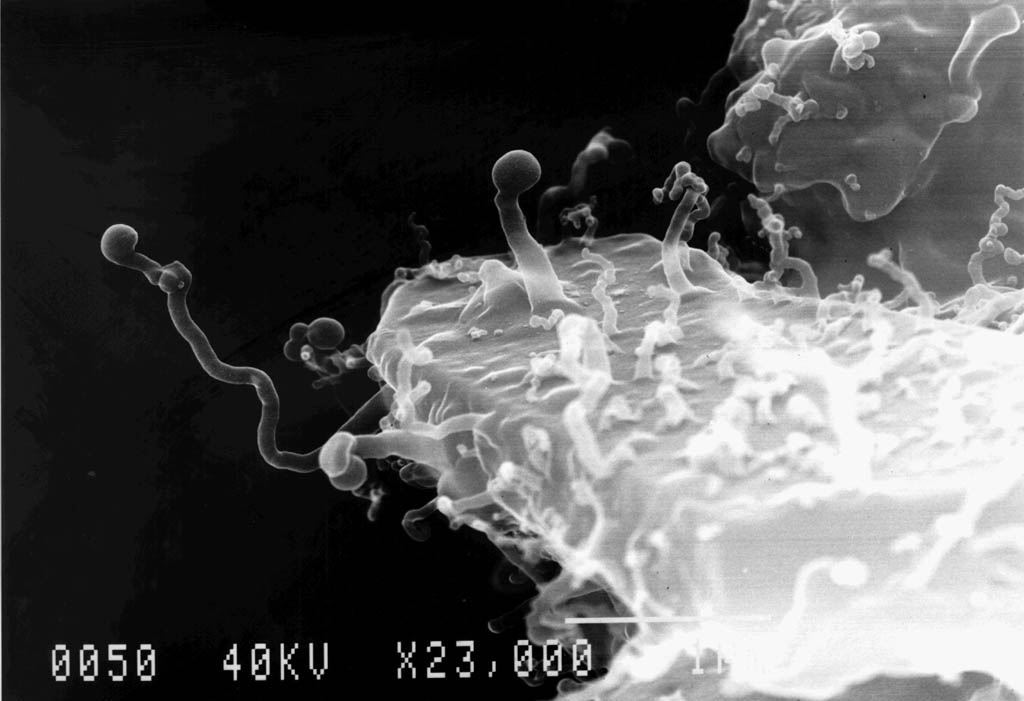
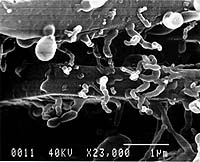
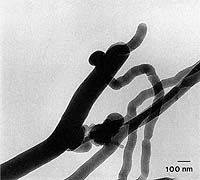
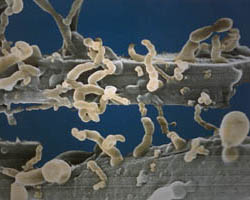
Until now living organisms in the size range of nanobacteria had not been found. The discovery of actively growing organic features in the same size range of the fossilised nanobacteria of others at the CMM represents the first evidence that novel organisms with these small dimensions do exist on earth. We refer to the nano-organisms identified on the sandstone samples as nanobes because their phylogeny has still to be established.
Nanobes have cellular structures similar to Actinomycetes and fungi (spores, hyphae and fruiting bodies) with the exception that they are up to 10 times smaller in diameter (25nm-1.0µm). They have hollow, membrane bound structures that are most likely composed of C, O and N. Whilst morphologically distinct, nanobes are in the same size range as the controversial nanobacteria described by others in a variety of different rock types and in the Martian meteorite ALH84001. Current and future research will focus on the establishment of axenic cultures for analysis of growth rates and for determining the nature of their genetic material.
Comments and Press:
“Ten times smaller than any living creature… with a bizarre appetite for plastic and with relatives that may have come from Mars… Nanobes are very strange creatures indeed. A young Australian geologist has possibly made one of the most significant biological discoveries of the last 100 years.” [source: http://abc.net.au/alienunderworld]
“Measuring as little as 20 nanometres – or 20 millionths of a millimetre – the so-called “nanobes” are not only smaller than any other life forms previously observed, but they are also smaller than thought possible under current biological theory.”
[source: http://www.abc.net.au/science/news/stories/s20156.htm]
Official Research Web Site
http://www.uq.edu.au/nanoworld/uwins.html
Read the entire scientific paper
http://www.uq.edu.au/nanoworld/documents/Nanobes.pdf
Useful Links:
From ABC
“Measuring as little as 20 nanometres – or 20 millionths of a millimetre – the so-called “nanobes” are not only smaller than any other life forms previously observed, but they are also smaller than thought possible under current biological theory.” http://www.abc.net.au/science/news/stories/s20156.htm
“Ten times smaller than any living creature… with a bizarre appetite for plastic and with relatives that may have come fromMars… Nanobes are very strange creatures indeed. A young Australian geologist has possibly made one of the most significant biological
discoveries of the last 100 years.” http://abc.net.au/alienunderworld/
http://abc.net.au/alienunderworld/ – ABC on Nanobes
http://www.microscopy-uk.org.uk/nanobes/ – Nanobes
http://www.abc.net.au/science/news/stories/s20156.htm – Nanobes
Other Related:
Transpermia – Exchange of Surface Material Among the Planets
http://www1.tpgi.com.au/users/tps-seti/swaprock.html
Is this a sign of life on Mars?
http://www.guardian.co.uk/Archive/Article/0,4273,3840997,00.html
Small is beautiful as nanobes reveal we are not alone
Physicist Paul Davies asks if tiny ‘microbe’ is missing link between life and non-life. http://www.guardian.co.uk/Archive/Article/0,4273,3840998,00.html
Important: Permission to use nanobe images should be gained by visiting the Discovery Team’s Web Site based at The Queensland University in Australia. http://www.uq.edu.au/nanoworld/uwins.html
Written by admin